



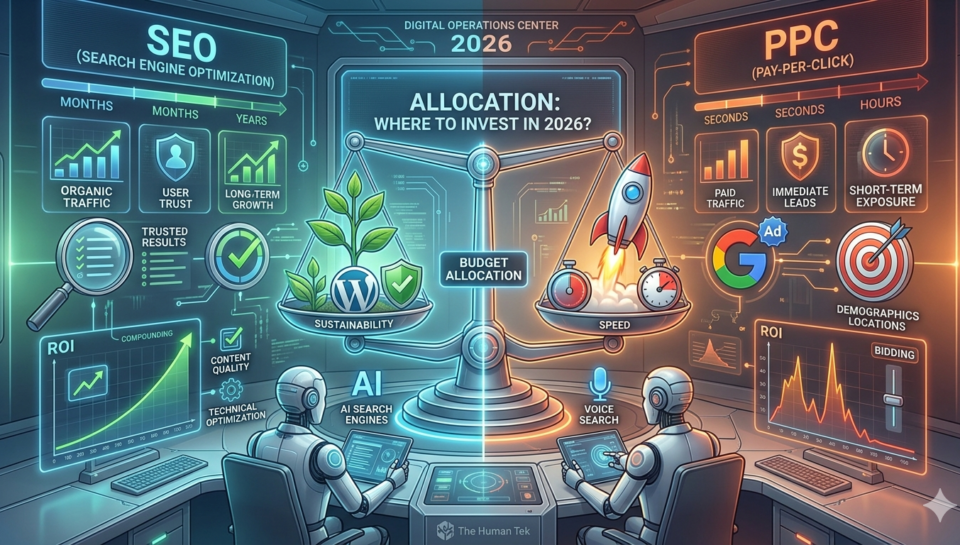
In 2026, digital marketing is evolving faster than it has ever evolved previously. With the help of AI-powered search engines, voice-activated search engines, and automated marketing software, companies continuously struggle to allocate their marketing funds. The challenge that business owners are facing today is SEO vs PPC- which one provides the most effective results?
Search Engine Optimization (SEO) involves making a site visible in search results through boosting its natural reputation over time. Pay-Per-Click (PPC), on the other hand, allows companies to pay in order to be at the top as soon as the search engine results pages are shown. The two approaches aim at attracting qualified traffic, but the process works in a totally different way.
The confusion is usually a result of budget allocation. Should a business invest in long term business development using SEO or seek short term exposure and short term leads using PPC? Understanding the mechanics of the two strategies would help business entities make smarter marketing choices to achieve success in growing sustainably in the competitive digital world in 2026.
The Core Difference Between SEO and PPC
The main difference between seo and ppc is that SEO generates organic traffic through search rankings, while PPC generates paid traffic through advertising platforms.
Organic traffic is obtained by means of optimization and content authority, whereas paid traffic is purchased on such advertising sites as Google Ads.
Companies that integrate SEO optimization services enhance the relevancy, technical efficiency, and quality of content on their websites to ensure that the search engines rank them without any form of manipulation. PPC ads, on the other hand, are based on bidding platforms where the advertiser pays on a per-click basis for their ad.
| Factor | SEO (Organic Traffic) | PPC (Paid Traffic |
| Cost | No direct cost per click | Pay for every click |
| Speed | Takes months to rank | Immediate visibility |
| Placement | Appears in organic listings | Appears as sponsored ads |
| Sustainability | Long-term traffic growth | Stops when the budget stops |
Despite the fact that their mechanisms are different, both strategies pursue the same aim, making them more visible and appealing to potential customers. The comprehension of this difference allows the businesses to weigh the advantages and drawbacks of the channels and then arrive at the conclusion which of the two approaches will best suit their marketing goals.
SEO vs PPC Pros and Cons: A Detailed Breakdown
Knowing the seo vs ppc pros and cons assists businesses in determining the best strategy that fits their aspiration, financial capacity, and development schedule. The two strategies are all part of the modern digital marketing strategies, yet they provide outcomes in highly different ways.
The Pros and Cons of SEO (Search Engine Optimization)
SEO is often considered a long-term investment that builds sustainable online authority. When done correctly, it can become one of the most powerful lead-generation channels for a business.
Pros of SEO
- Cost Efficiency: When a site is positioned well in search engines, the traffic that is generated to it does not involve paying per visitor. This renders SEO very economical in the long run.
- User Trust: Organic results have more users who trust them as compared to paid adverts. People also tend to ignore advertisements, and instead, they tend to click on organic listings because of banner blindness.
- Compounding ROI: Quality content and good optimization may create months or even years of traffic.
Cons of SEO
- Time Required: SEO rarely delivers immediate results. Businesses often need three to six months before significant rankings and traffic improvements appear.
- Algorithm Changes: Search engines constantly update their ranking algorithms, which can impact website visibility if optimization practices are outdated.
Ultimately, SEO works like a marathon rather than a sprint. Businesses that commit to consistent optimization build a digital asset that can generate leads around the clock without paying for every click.
The Pros and Cons of PPC (Pay-Per-Click)
PPC advertising provides a completely different approach to generating traffic. Businesses do not have to wait until their rankings increase; they can instantly put their advertisements at the very top of search engines.
Pros of PPC
- Immediate Visibility: PPC campaigns can increase traffic within a few hours of their initiation. This is what makes them the most suitable for businesses that would need exposure quickly.
- Advanced Targeting: Advertisers can target specific demographics, locations, devices, and search intent
- Measurable Performance: PPC platforms can provide a wholesome understanding of the campaign clicks, conversions, and performance.
Cons of PPC
- Rising Costs: Competition with high-value keywords is growing by the year, and this eventually increases the cost of advertising.
- Traffic Dependency: As soon as the advertising budget ceases, the traffic ceases.
- Lower Trust: Some users intentionally avoid ads because they prefer organic results.
PPC is a sprint, not a marathon. It provides instantaneous traffic and short-term sales prospects but necessitates steady advertising funding to sustain the performance.
SEO or Google Ads: Which Is Better for ROI?
When businesses evaluate marketing investments, they often ask: seo or Google Ads, which is better? This will be determined by the time and financial objectives of the firm.
PPC is more likely to provide quicker paybacks in the short run. Start-ups, new businesses, or companies that have new products will mostly use PPC campaigns to create instant traffic and initial sales. Paid advertising is also effective when it comes to penetrating a market quickly because one can attract targeted visitors within hours.
However, when comparing Seo Vs Paid ads ROI, SEO usually delivers stronger long-term returns. The higher the rankings that a website has, the lower the cost per acquisition becomes since the businesses will no longer be spending money per click. Even with a cutback in the marketing budgets, organic traffic can still generate leads.
Financially, PPC is best applied when the companies require an instant income, whereas SEO is better in terms of long-term profitability. Businesses having limited time and a good budget tend to invest in PPC, and those concentrating on long-term expansion tend to invest a lot in SEO.
When to Use SEO vs PPC (Strategic Scenarios)
Understanding when to use seo vs ppc helps businesses choose the right marketing strategy for different situations.
- Use PPC for Immediate Campaigns: PPC works best when launching a new product, promoting limited-time discounts, or running seasonal sales campaigns where instant visibility is required.
- Use SEO for Long-Term Growth: SEO is ideal for building brand authority, targeting informational search queries, and maintaining consistent organic traffic over time.
- Use Both for Maximum Impact: The most effective approach combines both strategies. Businesses can use PPC to identify high-converting keywords and then optimize content to rank for those terms organically through comprehensive digital marketing.
Instead of treating SEO and PPC as competing channels, successful companies in 2026 integrate both approaches to dominate search results and maximize visibility.
Why Design and UX Make or Break Your Campaign
Regardless of the seo vs ppc debate, website design and user experience play a critical role in campaign success. Search engines look at the interaction mechanisms of the users in the websites, and poor design not only does not favour the ranking but also the advertisement performance.
In SEO, page speed, mobile responsiveness, and content layout are some of the factors that determine search ranking. Google Quality Score also takes into consideration user experience in the PPC campaigns, which may influence ad placement and cost per click.
Companies that conduct professional graphic design and effective web usability usually have better engagement, more conversions, and better campaign results. Even the most effective marketing strategy would not result in meaningful outcomes without a good foundation for a website.
The Final Verdict
SEO and PPC have their competitive advantages, although they are not used in a digital marketing strategy with the same intent. SEO creates credibility in the long term and long-term traffic, whereas PPC gives immediate visibility and lead generation. One-dimensional businesses usually lack valuable growth prospects.
Companies ought to analyse their objectives, competition, and their marketing budget rather than making assumptions about what strategy to adopt. Overall, to achieve the successful combination of two methods, experts at The Human Tek help businesses create customized strategies that combine SEO and PPC effectively.
When you are still uncertain about the choice between seo vs ppc, the next thing to do is to hire a professional digital audit and calculate the appropriate proportion of your business development in 2026.