



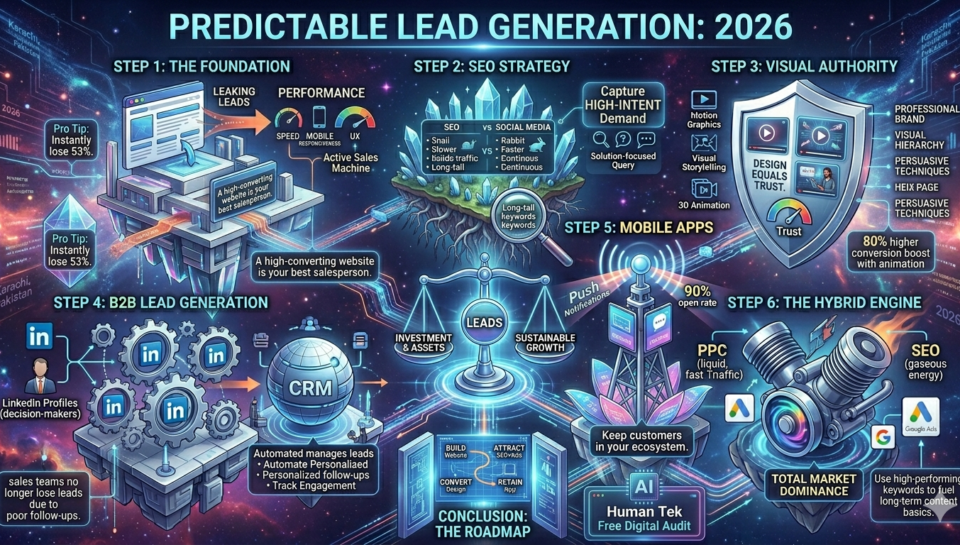
Most businesses don’t fail because their product is bad. They fail because nobody ever discovers them. It is all about visibility to survive. It is possible to develop the best service, the best product, and the best price, but without a consistent system of lead generation, growth cannot be achieved.
This guide describes how to generate leads online using an organized system rather than random tactics. No shortcuts. No tricks in marketing. Only proven digital infrastructure that will have a steady appeal and conversion of customers.
At The Human Tek, this exact system powers scalable growth for our clients across multiple industries. It focuses on building assets that compound over time instead of chasing temporary traffic spikes. These steps should be used to create a predictable customer acquisition and conversion system through digital marketing for leads.
Step 1: The Foundation – Why Your Website is Leaking Money
Lead generation for small businesses is your first critical asset to your website. Most companies assume that they have a marketing problem, yet in an actual sense, they have a conversion problem.
Their website is more of an online brochure, rather than a sales machine.
Tourists come and go without doing anything. This is normally due to three technical factors:
- Speed: Sluggish websites kill conversions. The visitors give up pages even before loading.
- Mobile responsiveness: More than 60 percent of customers are browsers. In case of any failure of navigation on mobile screens, leads will vanish immediately.
- User experience (UX): The layouts of the websites are confusing; they compel the visitors to seek information rather than lead to action.
Making such issues fixed makes a passive website an active lead generation site. The conversion path is taken by strategic layouts, optimum landing pages, and clear CTAs.
Pro Tip:
If your site takes more than three seconds to load, you instantly lose 53% of potential traffic.
This is why investing in high-performance web development becomes the first step toward a predictable growth engine
A high-converting website isn’t an expense; it’s your best salesperson.
Step 2: SEO Strategy – Capturing High-Intent Traffic
Online lead generation strategies become powerful when businesses understand user intent. Not all traffic has equal value. Social media traffic usually comes from people browsing casually, while SEO traffic comes from people actively searching for solutions.
That difference changes everything. When someone types a search query into Google, they are hunting for answers. Ranking for those search positions puts your business directly in front of motivated buyers. Instead of chasing attention, SEO captures existing demand.
Below is a simple comparison showing the difference.
| Factor | SEO | Social media |
| Cost | High initial investment, low long-term cost | Continuous ad spend required |
| User Intent | High purchase intent | Mostly passive browsing |
| Long-Term Value | Builds traffic assets over time | Traffic disappears when ads stop |
The most effective strategy targets long-tail keywords—specific search phrases buyers use when they are ready to act.
Examples include solution-focused searches, industry-specific questions, and service-based queries.
Implementing advanced SEO optimization allows businesses to capture these opportunities and build organic traffic that compounds over time.
Stop paying for every click. SEO builds an asset that pays dividends for years.
Step 3: Visual Authority – Why Design Equals Trust
It takes only 0.05 seconds before visitors make judgments about a website. It implies that trust is predetermined by design even before a word is read. When the layout is outdated, users may think that the company is outdated, and when the layout is amateur, the product will be deemed unreliable.
Good design is a sign of professionalism, authority, and reliability. This is the reason why visual storytelling has become a strong conversion tool. Explainer videos, interactive graphics, and animation are able to make complex concepts easy to understand and keep the user longer. By 80 percent, the landing pages with the animation or explainer video can boost conversions.
This is one psychological factor that is ignored by businesses that are wondering how to get clients online. Design is not about decoration, but persuasion.
Elements that influence trust include:
- Professional brand identity.
- Uninterrupted visual hierarchy.
- Hiring of motion graphics.
- Understanding visual storytelling.
The services of professional 3D animation services are frequently employed by companies that have to convey value in the shortest time possible and capture attention within the first several seconds of interaction.
You wouldn’t wear a dirty suit to a sales meeting. Don’t let your website wear a bad design
Step 4: B2B Lead Generation Ideas (The “LinkedIn & CRM” Approach)
B2B marketing requires a completely different approach from traditional consumer marketing. The fastest way to generate high-value leads in B2B markets is by combining LinkedIn outreach with automation systems. LinkedIn works because decision-makers already spend time there, and founders, executives, and managers actively evaluate partnerships and services on the platform.
However, manual outreach limits scale. This is where automation becomes powerful.
Businesses integrate LinkedIn prospecting with custom CRM software that manages outreach pipelines automatically.
These systems can:
• Identify target prospects based on job titles and industries
• Capture contact data and enrich lead profiles
• Automate personalized follow-up sequences
• Track engagement and responses
The key is intelligent automation—not spam. Properly configured systems send personalized messages triggered by user behavior, ensuring outreach remains relevant and professional. Sales teams no longer lose leads due to poor follow-ups or disorganized pipelines.
In B2B, the money is in the follow-up. Automate it so you never miss a deal.
Step 5: Mobile Apps – The Ultimate Retention Tool
Lead generation does not end after someone becomes a customer. Retention multiplies revenue. A website captures leads, but a mobile app keeps users connected to your brand ecosystem. Businesses that invest in mobile app development gain a direct communication channel that bypasses crowded email inboxes and algorithm-controlled feeds.
Push notifications are the most powerful example. They achieve open rates of up to 90%, making them one of the most effective marketing channels available today.
Mobile apps also improve engagement through features like:
• personalized dashboards
• instant updates and alerts
• in-app purchases
• loyalty programs
Instead of repeatedly acquiring new customers, apps encourage repeat engagement and long-term brand loyalty. This drastically increases customer lifetime value. Don’t just get leads, keep them in your ecosystem with a branded mobile app.
Step 6: The “Hybrid Engine” – Combining Paid Ads (PPC) & SEO
The best businesses never have a single source of traffic. They are both fast and sustainable. Consider PPC advertising the gas pedal; it attracts traffic at once, whereas SEO is the engine, the powerhouse of future growth. The combination of the two forms a hybrid marketing engine.
Google Ads and other paid advertising platforms enable a business to experiment with various keywords and customer groups. In a few days, marketers will be able to determine which search terms produce the greatest conversions. The high-performing keywords are then used as the long-term SEO content basics. This will minimize the guesswork, and the content will be based on the known revenue opportunities.
Companies that consistently master generating leads online consistently dominate both paid and organic search results.
With holistic, comprehensive digital marketing, businesses will be in a position to drive traffic to all available channels.
Conclusion: The “No-Excuses” Roadmap
Successful lead generation follows a system, not random tactics. Initially, establish the infrastructure using high converting site. Second, bring in qualified traffic through SEO and paid advertising. Third, transform visitors with professional design and a convincing visual narrative. Lastly, keep customers on board through mobile applications and automated CRM software.
The entire growth engine will resemble the following: Build (Website) + Attract (SEO + Ads) + Convert (Design) + Retain (App). The implementation of this system needs skills in development, design, automation, and data strategy.
You may employ several freelancers and handle it on your own. Or you might also make a deal with one team that has the whole system running.
It all begins with a Free Digital Audit and finding out how your existing infrastructure is working–and where your biggest lead opportunities lie.